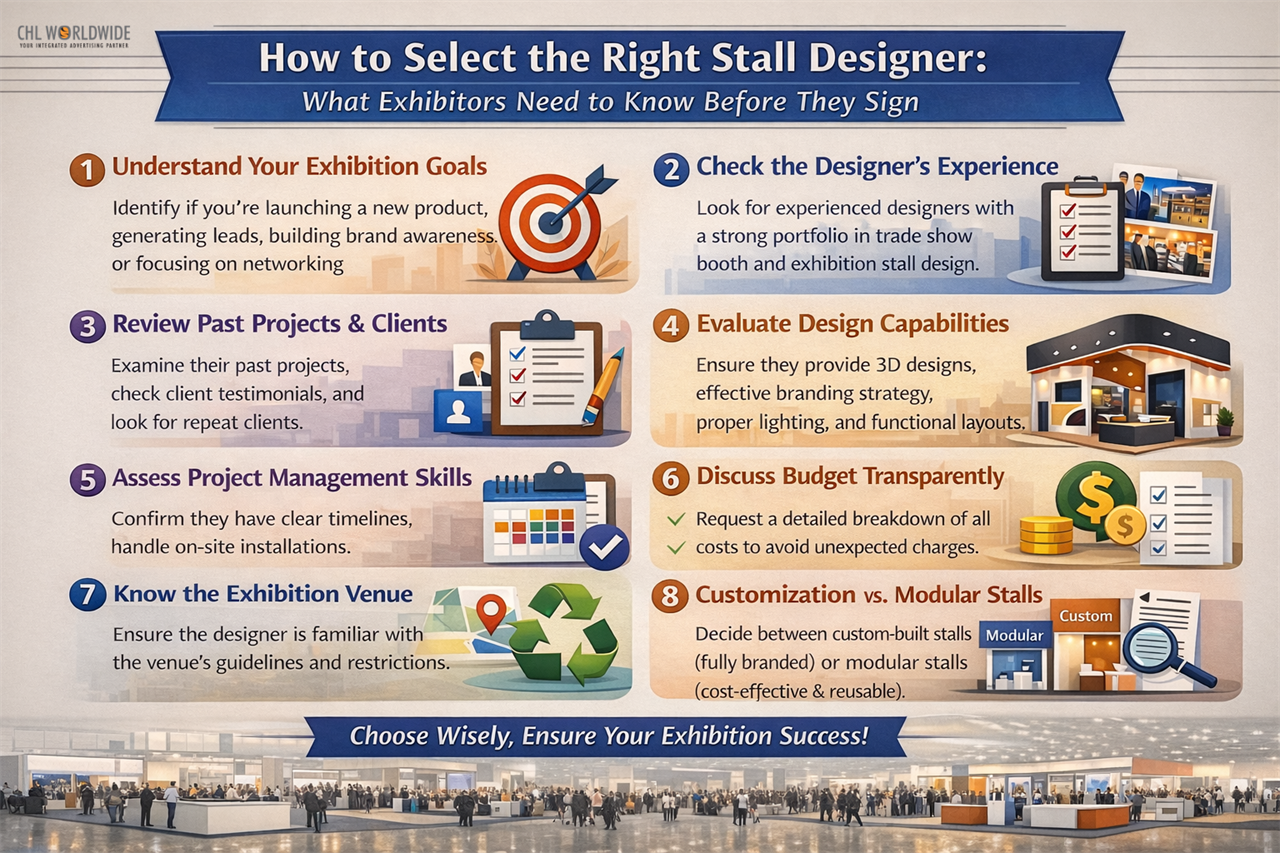
How to Select the Right Stall Designer: What Exhibitors Need to Know Before They Sign

27-Feb-2026
There is a moment at every trade show - usually around mid-morning on the first day - when you can tell which exhibitors chose their stall designer well and which ones didn't. Some stalls have a natural energy to them. People drift in without being called over. The layout makes sense. The lighting hits the product at the right angle. The graphics tell a story without shouting. Other stalls, despite a generous budget, feel flat — like someone followed a template rather than thought about the brand.
The difference, almost always, begins at the design stage.
Choosing a designer for an exhibition stand isn't just finding someone who can create a visually appealing 3D image or graphic; it also involves finding someone who understands how space interacts with a company's brand identity, human behaviour, and the purpose of doing business. Finding someone who possesses all those skills is more difficult then most people think.
The guide can help you select the right designer, whether you're an exhibitor for the first time or have exhibited many times before.
What a Stall Designer Actually Does
Before we get into how to choose one, it helps to be clear about what a stall designer is actually responsible for.
A good stall designer does far more than produce a visual. They evaluate your exhibition goals to determine whether you're showcasing a product, acquiring leads, facilitating comfortable meetings, building overall brand exposure or a combination of all of these. In addition, they research your brand style guide, identify your target audience and design the physical layout of the exhibition space for maximum convenience and ease of traffic for the visitors who attend.
To do this, they research the sight lines of your booth from a distance. In addition, they look at the traffic flow from both the perspective of the visitors and the exhibitor, how to best use counters and screens while also creating natural opportunities for staff and visitors to engage in conversation. In addition, they evaluate how they would use lighting not only to give the exhibition space a more elegant and upscale appearance. They will also assess using lighting as a tool to help draw the visitor's eye.
A stall designer who only thinks about how the render will look on a presentation slide is not truly designing your exhibition experience. They are decorating a box.
Understand the Difference Between a Designer and a Visualiser
This distinction is subtle but important. A visualiser is skilled at producing polished 3D images that look impressive in a presentation. A designer is someone who has thought deeply about the strategy behind the space — and the visual output is the expression of that thinking, not the starting point.
When you first speak with a potential stall designer, pay attention to what questions they ask you. A visualiser will ask what the stall dimensions are and what colours your brand uses. A true designer will ask what outcomes you want from the exhibition, who your typical visitor is, how many team members will be working the stall, whether you need private meeting space, and what your competition typically does at this show.
If the first conversation is mostly about aesthetics, that tells you something. The best designs emerge from the right questions, not the right mood board.
Ask to See Thinking, Not Just Finished Work
Every stall designer will show you a portfolio of finished projects. Ask to see more. Ask whether they can share early concept sketches, mood boards, or design rationale documents for past projects. Ask them to explain the brief they were given and how their design responded to that brief.
This reveals whether the designer has a genuine process or simply has a style they apply to every project regardless of the client's needs. A stall for a pharmaceutical company at a medical conference should look and feel fundamentally different from a stall for a technology startup at a consumer electronics show. If a designer's portfolio looks remarkably consistent regardless of industry or context, that is a sign they are designing for their own aesthetic preferences rather than for their clients' objectives.
Variety in a portfolio — real variety, not just different colour schemes applied to the same structure — is a mark of a designer who listens before they draw.
Look for Spatial Intelligence, Not Just Graphic Talent
Exhibition stall design sits at the intersection of interior design, graphic design, and experiential design. A designer who excels at creating beautiful graphics may struggle when it comes to thinking in three dimensions — understanding how a space feels to be inside, how the structure will look at various angles as visitors approach, and how different ceiling heights or open versus enclosed layouts affect the mood of the space.
Conversely, a designer with strong spatial intelligence may not always produce the most refined graphic work. The best stall designers either possess both skills or work as part of a team where graphic designers and spatial thinkers collaborate closely.
When evaluating a designer, ask specifically: who handles the structural concept, and who handles the graphic and branding elements? Understanding the team structure tells you a great deal about the quality of what you will receive.
At CHL Worldwide, our design studio brings together spatial designers and visual communication specialists who work together from the initial brief — not in silos that produce a structure and then paste graphics onto it at the end.
Verify They Understand Fabrication Constraints
A stall design that cannot be built, or that can only be built at three times the estimated cost, is not a good design. It is a good idea on paper that someone else will have to figure out how to implement.
The best stall designers either work directly within a fabrication company or have deep, practical knowledge of how structures are built — what materials behave like at scale, what can realistically be transported and assembled within a standard venue setup window, and what design elements look sharp when fabricated versus what looks good on screen but muddy in execution.
Ask your designer whether they have worked closely with fabrication teams. Ask whether they have been on-site during installation for past projects. A designer who has watched their concepts being built learns very quickly which ideas translate beautifully and which ones cause headaches. That experience makes their future designs better, more buildable, and ultimately more cost-effective for clients.
Evaluate Their Ability To Conform To Your Brand Guidelines.
Your exhibition stall is not just a blank canvas. It is an extension of your brand. Therefore, it should be consistent with your website, packaging, advertising, and all other touchpoints that your potential audience has encountered before they walk into the exhibition hall.
Some designers will be willing to put their own dislikes aside so that they can produce work based on the needs of a clearly defined brand. Others will have a signature style that overshadows and dominates their work. If your brand clearly defines who you are and has a strong, established visual language, then you need designers who will build on and respect your brand's visual identity rather than an individualistic designer who has a very personal aesthetic representation.
Provide your designers with your brand guidelines when you first start working with them, and this should include everything from your logo and colour palette to your brand story, vision and examples of successful brand communications. Observe how your potential suppliers react. Does their proposal represent a natural extension of your brand's identity? Or does it mainly provide their work with the addition of your logo?
Think About Reusability From the Start
The best designs are made while keeping modularity and reusability in mind. The components will be able to be reconfigured for different booth sizes, key graphic panels can be updated without rebuilding the entire structure, and a design language flexible enough to accommodate product launches or messaging changes from one show to the next.
The designer’s approach towards these is crucial. Ask whether the design they are proposing can be adapted for a 3x3 shell scheme at a smaller regional show as well as the 10x10 island stand they are currently designing. A designer who thinks about the long arc of your exhibition programme, not just the immediate project, is a more valuable partner.
Making the Final Decision
When you have evaluated two or three stall designers against these criteria, the right choice usually becomes clear. It is rarely the cheapest option and not always the one with the most impressive-looking portfolio. It is almost always the designer who understood your brief most completely, communicated most clearly, and gave you the most confidence that they will deliver — not just a beautiful render, but a stall that actually works.
At CHL Worldwide, our design philosophy begins with understanding what success looks like for each individual client at each individual show. We believe that a well-designed exhibition stall is not a luxury — it is a competitive tool. And like any tool, it works best when it is designed for the specific job it needs to do.
Ready to talk about your next exhibition? Reach us at info@chlworldwide.com and let's start the conversation.
LATEST ITEMS
OUR FAVORITES

30-june-2022
29-june-2022